

The opening minute of an interview is easy to overlook until you’re in it. The interviewer smiles, leans back, and asks some version of the same prompt. “Tell me about yourself.” “Walk me through your resume.” “How did you end up in this field?”
You start talking. Somewhere around the second sentence, you can feel it start to wander. You move through roles in order. You try to explain a gap. You circle back to where you started and land with something like, “and yeah, that is basically me.”
That opening minute is one of the most underused opportunities in any interview.
It is the only part of the conversation where you control the narrative without interruption. The interviewer is not testing your memory. They are trying to understand how you think about your career. The candidates who handle this well are not just sharing their background. They are showing their judgment, their self-awareness, and the reasoning behind the choices they have made.
That is what this edition is about. Last week we covered the questions you should be asking in every interview. This week, we turn the lens inward.
The Midweek Check-In
Before we get into the framework, take five minutes and answer three questions honestly.
How would you describe your career to a stranger at a professional conference right now? Not your title. Not the company name. The story behind how you got here. Why you made the moves you made. Where you are headed. If that answer feels scattered or too long, this is exactly what we are going to bring into focus.
When was the last time you said your professional story out loud? Not in your head. Out loud, to another person or even to yourself. There is a meaningful difference between knowing what you want to say and being able to say it with confidence and natural pacing.
Is there a gap, a lateral move, or a career change in your history that you hesitate to explain? Write down the real reason it happened in one sentence. That is the version you want to be able to share clearly and comfortably.
If these answers feel unclear or harder to say than they should, that is exactly what we are going to walk through together.
This is where you start.
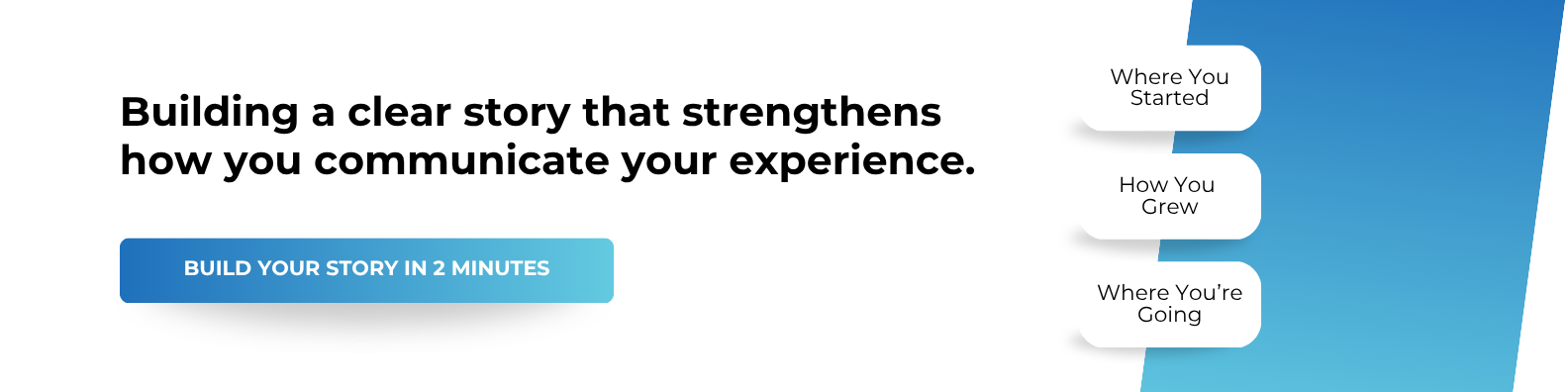
Professional Story Builder – a simple tool to help you shape your story into a clear structure you can share with confidence in under two minutes.
Answer a few short prompts about where you started, how you grew, and where you are going. The builder organizes your answers into a smooth, easy-to-follow story you can practice out loud before your next interview.
→ Build Your Professional Story in 2 Minutes
The tool is free. Enter your first name, last name, and email to access.
The Shift That Changes Everything
The candidates who tell their story well tend to approach it a little differently. They stop treating their background as something they need to explain and start using it as a way to show how they think.
It is a subtle shift, but it changes how the entire conversation feels.
When your story feels like an explanation, it often focuses on the past. It tries to fill in gaps, clarify decisions, and anticipate questions that may not even come up.
When your story is more intentional, it does something different. It highlights the decisions you have made, the direction you have taken, and the way your experience has shaped how you approach your work.
Every role you mention, every transition you describe, and every example you choose becomes a window into your judgment. The interviewer is not trying to reconstruct your resume. They are listening for how you make sense of your own career.
Everything in this edition builds from that shift.
The goal of your professional story is not to prove you are qualified. It is to help the person across the table understand how you think about your work, your decisions, and your direction, so that by the time you finish speaking, the fit feels clear.
The Framework: Your Professional Story, Simplified
After coaching professionals through thousands of interview processes, the strongest stories we hear consistently follow the same structure. Simple enough to remember. Flexible enough to adapt to any interview. Clear enough that the person across the table understands your trajectory in under two minutes.
Where You Started
Start with why you chose this field. Not your entire education history. Not your first job out of college unless it is directly relevant to the work you do now. This section establishes professional context for everything that follows.
For healthcare professionals, this often sounds like the moment you entered the industry. A clinical documentation specialist might reference how they moved from bedside nursing into CDI after recognizing the gap between what clinicians documented and what the data actually captured. A revenue cycle analyst might reference the moment they realized clean claims were not an administrative function but a financial one.
This should take 20 to 30 seconds. Two or three sentences. It answers one question: how did you get into this work, and what pulled you in?
Quick check: Can you explain why you chose this field in one sentence without defaulting to your job title?
How You Grew
This is the body of your story. It is where you bring your experience into focus by connecting the decisions behind your career moves.
Rather than walking through every role, focus on the moments that shaped your direction. You are helping the interviewer see how your experience builds over time and how each step contributed to where you are today.
Choose two or three pivotal experiences. For each one, briefly name the role, describe the challenge or opportunity that stood out, and explain what you carried forward into the next step.
The goal is not to cover everything. It is to highlight the experiences that shaped how you approach your work.
Quick check: Are you showing how your decisions connect, or simply listing your roles?
About the Gap You Dread
f you have a gap, a lateral move, or a career change in your history, this is where you can address it directly.
One sentence is enough. Keep it clear and straightforward.
“I stepped away for a year to manage a family health situation and came back with a clearer sense of what I wanted in my next role.”
“I moved laterally into compliance because I wanted to understand the regulatory side of the work before moving into leadership.”
Keep it simple. Keep it confident. The gap is part of your story, not something separate from it.
The section should take 45 to 60 seconds. It answers the question: what have you done, and why does it matter?
Where You’re Going
This is where you land. It connects your story directly to the role you are interviewing for and explains why this opportunity makes sense as the next step.
This should feel like a natural conclusion. You are showing how your experience aligns with where you want to go next.
“That experience is what led me to this conversation. The work your team is doing in clinical documentation integrity aligns with where I have been building my career, and I am looking for a place where I can bring that experience to a team that is scaling.”
Quick check: If you stopped here, would it be clear why this role makes sense for you?
Where Most Stories Fall Apart
Once you understand the structure, it becomes easier to see where a story can lose focus.
Starting too far back
If your opening leans heavily on where you went to college and you have been working for several years, it can pull the conversation away from your current direction. The goal is to establish professional context, not walk through your full background.
Listing instead of connecting
“Then I worked at Company A. Then I moved to Company B. Then I went to Company C.”
This creates a timeline, but it can miss the opportunity to show how your decisions connect. The interviewer can already see your roles. What helps them most is understanding why you made those moves and what you took from each one.
Keeping it too general
“I did a lot of process improvement” can be hard to picture.
“I redesigned the coding audit workflow and reduced the denial rate by 18 percent in six months” gives a clear sense of your impact. Specific examples help your experience come through more clearly.
Practicing it word for word
Having a structure is helpful, but your delivery should still feel natural. When it sounds memorized, it can lose some of its authenticity. Focus on the key points, and let your language stay flexible each time you tell it.
Stopping before you connect it forward
Sometimes the story ends without clearly tying back to the role you are pursuing. Taking a moment to connect your experience to what you are looking for next helps the conversation land more clearly.
Your Strategy Through Friday
If you have an interview this week or next
Write out your story tonight using the three parts. Time yourself saying it out loud. If it runs longer than two minutes, tighten it. If you’re walking through too many roles, consolidate. Practice it twice more before the interview. Not word for word. Focus on structure, then let your language stay natural.
If you are actively searching
Record yourself delivering your story on your phone. Play it back. Listen for filler words, unclear transitions, and where you lose momentum. Most people are surprised by the gap between how they think they sound and how they actually come across. Five minutes of this will do more than an hour of passive prep..
If you are earlier in your search
Write your story down this week, even if you are not interviewing yet. Having it ready removes one of the biggest sources of pressure when an opportunity comes up. Treat it like something you maintain, not something you build under stress.
The Midweek Mindset
Your professional story is not a defense of your resume. It is a demonstration of how you think about your career.
The candidates who tell it well are not always the ones with the most impressive backgrounds. They are the ones who understand their own trajectory and can explain it clearly.
Before you close this, take two minutes and say your story out loud once.
Wednesday is the right day to build that clarity. The week is not over. There is still time to sharpen the story before you need to tell it.
Next Wednesday in Edition 3: how to read the room in real time and adjust when the interview shifts under you.
LinkedIn | TikTok | Instagram | Facebook | Website | X (Twitter) | Job Board