

Every interview has two conversations happening at the same time. The one you are speaking out loud. And the one unfolding in the room around you.
The good news is that most people are already doing the first one well. They come prepared. They know their story. They have thought through the tough questions.
But the second conversation is where everything clicks.
The moment the interviewer leans in because something you said really landed. The follow-up question that tells you exactly what they care about. The shift in energy when it stops feeling like an interview and starts feeling like a real conversation.
Those signals are there in every interview. And when you know how to read them, you stop feeling like you are just answering questions and start feeling like you are actually connecting.
That is what this edition is about. Edition 01 gave you the questions to ask. Edition 02 gave you the structure to tell your story. This week, we focus on the skill that separates a good interview from a great one.
The Midweek Check-In
Before we get into the framework, lets take a few minutes to think through a few questions.
Think about the last interview or professional conversation that stood out to you. What was the moment it shifted? A question you were not prepared for? A change in the interviewer’s tone? A topic that came up out of nowhere? Identifying that pivot point is the first step to handling the next one with more confidence.
When you are in a conversation that is going well, do you notice what is working? Or do you only become aware of the dynamic when it starts to change? The professionals who perform best in high-stakes conversations pay attention to both signals, not just the obvious ones.
Is there a type of question or conversational dynamic that consistently challenges you? A behavioral question you want to answer more clearly? A panel format where you want to feel more natural and connected? Name it. That is where your preparation energy belongs this week.
The Interview Room Reader
Most of these shifts only become obvious after the conversation is over. If you want a way to start recognizing them in real time, we put together a simple tool to help you think through how to respond as they happen.
→ Try The Interview Room Reader before your next interview
The tool is free. Enter your first name, last name, and email to access.
The Shift That Changes Everything
The candidates who read the room well tend to make one mental shift that changes how their interviews unfold. They stop performing and start participating.
When an interview feels like a performance, it becomes one-directional. The candidate delivers prepared answers, keeps an eye on how they are coming across, and waits for the next prompt. The focus stays internal. Success becomes about whether they said everything the “right” way, while most of what is happening on the other side of the table goes unnoticed.
Participation feels different. The candidate is still prepared and still clear on their answers, but their attention is in the room rather than in their own head. They notice shifts as they happen. They adjust in real time. The interview starts to feel less like a sequence of questions and more like a conversation between two professionals trying to understand whether the fit is right.
Everything in this edition builds from that shift. The goal is not to stop preparing. It is to stay flexible enough with your preparation that you can remain present in the conversation as it actually unfolds.
The Framework: Four Signals to Watch and How to Respond
After years of debriefing candidates after interviews, four specific signals show up consistently as the moments that separate strong performances from missed opportunities. You will not catch all four in every interview. But learning to recognize even one of them in real time puts you in a very different position than most of the candidates you are competing with.
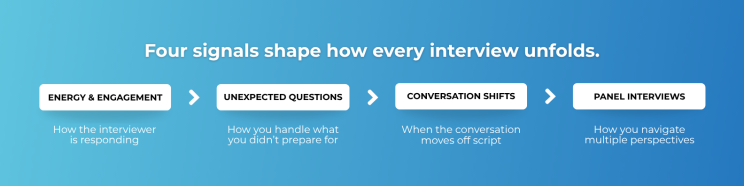
The Interviewer’s Energy and Engagement
This is the most immediate feedback you get in an interview, and it is easy to miss when your focus is on your own delivery.
When an interviewer leans forward, asks follow-up questions, or says something like “that is interesting, tell me more,” they are engaged. This is your signal to go deeper. Expand on the point with a specific example. The conversation has found a thread that matters to them. Your job is to follow it.
When an interviewer starts glancing at their notes, gives shorter responses, or moves quickly to the next question, the energy has likely shifted. This does not mean you said something wrong. It often means the topic is not as relevant to what they are evaluating, or that you have gone further than the moment required.
Your adjustment is simple. Tighten your response. Get to the point a little faster. Bring the conversation back to what matters most for the role.
The key is noticing the shift as it happens rather than trying to piece it together afterward. In your next conversation, set a simple intention to check the interviewer’s body language and response pattern after each answer you give.
The Unexpected Question
Every interview includes at least one question you did not prepare for. How you handle that moment often says more than any rehearsed answer.
The instinct for most candidates is to fill the silence immediately. Give yourself a second instead. A brief pause signals that you are thinking, not stalling.
“That is a great question. Let me think about that for a moment.”
That is a complete answer in itself. It gives you a few seconds to collect your thoughts, and experienced interviewers expect it.
If the question is outside your direct experience, say so with confidence. Then walk them through how you would approach it based on what you have seen in similar situations. A thoughtful approach is always stronger than trying to force a perfect example that does not quite fit.
If a question feels more challenging than expected, it may be intentional. Some interviewers use those moments to understand how you respond under pressure. Your goal is to stay steady. Answer the question directly without matching the intensity. How you carry yourself in that moment often leaves a stronger impression than the answer itself.
The Conversation That Goes Off Script
Not every interview follows a linear path. Some interviewers are conversational by nature. Others are reacting to something you said that took the discussion in an unexpected direction. Either way, the interview has moved away from the questions you prepared for.
This is not a problem. It is often an opportunity. When an interviewer goes off script, they are usually exploring something that genuinely interests them about your background or perspective. Follow their lead. Stay present in the conversation rather than trying to redirect back to the points you planned to make.
The One Exception
If you are 30 minutes in and the interviewer has not asked about your relevant experience for the role, it is appropriate to bring it back.
“I am enjoying this conversation. I also want to make sure we cover my experience with clinical documentation integrity, since I know that is central to this role.” This is not interrupting. It is advocating for yourself with professionalism.
The Panel Dynamic
Panel interviews introduce a layer of complexity that one-on-one conversations do not have. Multiple interviewers means multiple priorities, multiple communication styles, and multiple people whose engagement you need to manage simultaneously.
The most common mistake in panel interviews is directing every answer to the person who asked the question. Begin your answer by making eye contact with the person who asked, but then shift your attention across the panel as you continue. This is a small adjustment that makes a significant difference. It signals that you are speaking to the team, not performing for one evaluator.
Watch for the quiet panelist. In most panels, one person speaks less than the others. That person is still evaluating. If they ask a question late in the interview, give it your full attention and a thorough answer. Their questions are often the most deliberate because they have been listening and waiting to ask something specific.
If panelists appear to disagree or have different priorities, do not try to navigate the internal dynamic. Answer the question directly, acknowledge that different stakeholders may have different perspectives, and focus on the substance. You are not there to mediate their priorities. You are there to demonstrate that you can navigate complexity with professionalism.
Using These Signals Strategically
Reading the room is not a passive skill. It is something you practice with intention.
Do not wait until the interview to think about it. Before you walk in, decide which one of the four signals you want to track most carefully. One is enough. Trying to monitor all four at once pulls you out of the conversation and back into your own head, which is exactly what we are trying to avoid.
Match your attention to the interviewer in front of you. A hiring manager is usually reading for fit and judgment, so their energy shifts are the signal to watch. An HR represenative is usually reading for consistency, so the unexpected question is more likely to surface. A peer interviewer is often reading for collaboration, so the off-script conversation is where the real evaluation happens.
Debrief yourself after every interview. Within 15 minutes of the conversation ending, write down one moment the energy shifted and what you did in response. The candidates who grow fastest in this skill are the ones who build a personal record of these moments over time.
Your Strategy Through Friday
If you have an interview this week or next
Before you walk in, set three intentions. First, you will check the interviewer’s engagement level after every answer you give. Second, you will pause before answering any question that catches you off guard. Third, you will follow the conversation wherever it goes rather than forcing it back to your script. These three adjustments are simple, and they change the quality of the interaction immediately.
If you are actively searching and practicing
Find a friend, a mentor, or a fellow job seeker and do a mock interview this week with one rule: the person interviewing you is allowed to go completely off script. Ask them to throw in unexpected questions, change topics abruptly, and vary their energy level. Your only objective is to stay present and adjust. This is not about getting the answers right. It is about building the muscle of reading the room.
If you are earlier in your search
Spend 15 minutes this week watching a recorded interview or professional panel discussion. Turn the sound off for the first two minutes and watch only the body language. Notice when the person being interviewed is connecting with the interviewer and when the energy drops. Training your eye to see these dynamics in others is the first step to recognizing them when you are in the room yourself.
The Midweek Mindset
The best interviews do not feel like interviews. They feel like conversations between two professionals who are evaluating whether the fit is right. That dynamic only happens when you stop performing and start paying attention to what is actually happening in the room.
Preparation gives you confidence. Presence gives you connection. Both matter, but the candidates who can do both at the same time are the ones who walk out of interviews knowing they showed the full picture of who they are.
Wednesday is the right day to practice being present. The week is not over. There is still time to sharpen this before your next conversation.
LinkedIn | TikTok | Instagram | Facebook | Website | X (Twitter) | Job Board