

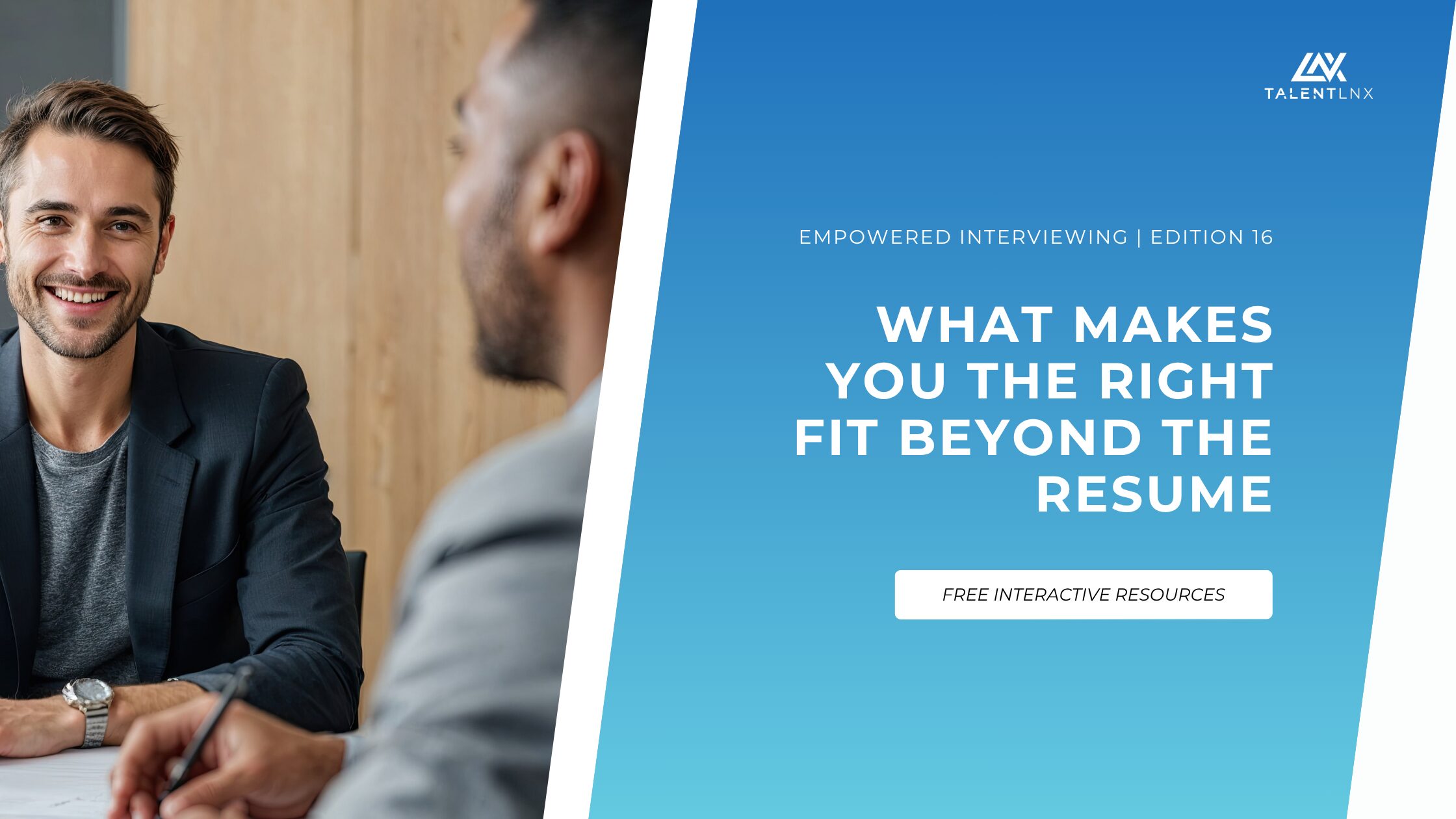
What Makes You the Right Fit Beyond the Resume
Qualifications get you into the room. They rarely decide what happens once you are in it.
Two people can walk into the same interview with nearly identical resumes and have two completely different conversations. Same experience. Same credentials. Same responsibilities. On paper, interchangeable.
In practice, one conversation can leave a hiring team confident, and the other can leave them unsure. The resume does not explain the difference. What does is harder to put on paper: how you think, how you communicate, what you are like to work with.
AI has only raised the stakes. Nearly every resume can now be polished to look strong on paper, which means the resume decides less, and the parts of you it cannot capture decide more. Your credentials make you qualified for the role. The person behind them is what makes you the right fit.
That is what this edition is about.
The Midweek Check-In
Before we get into the framework, let us take a moment to pause and think through three questions honestly.
Think about an interview that went well, the kind where the conversation just flowed. Most of us remember those moments as chemistry, a bit of luck, the right day. But if you look closer, it was rarely luck. It was how you were thinking out loud, how you listened, how you talked about work you actually care about. The part that felt effortless was often the part doing the most.
When you prepare for an interview, where does your energy usually go? For most of us, it goes straight to the qualifications, the experience, the answers we can rehearse. It makes sense, because that is the part you can control. The harder part to prepare, how you actually come across, is the part a hiring team is often weighing most.
Have you ever thought about the parts of yourself that never make it onto a resume? How steady you are when something goes sideways. The questions you think to ask. How people feel after working with you. We rarely think to claim those things, and yet they are often what a team is really deciding on.
Your Free Resources This Week
These tools are designed to support and guide your professional journey and are provided for informational purposes only. Individual experiences, circumstances, and outcomes will vary.
If you want to walk into your next interview clear on the strengths that make you stand out, the Fit Beyond the Resume tool below is built for exactly that. It walks you through the qualities that tend to decide a hire and helps you name the ones that are genuinely yours, the strengths that do not fit neatly into a bullet point but show up the moment you are in the room. Once you have that, the Value in Words tool helps you put language to them, so the things that are hard to describe about yourself become things you can actually say clearly when it counts.
→ Build My Fit Beyond the Resume
The tools are free. Enter your first name, last name, and email to access.
What Actually Makes You a Fit
Once your qualifications are established, a hiring team is quietly weighing a handful of things a resume was never built to hold. And these are not soft preferences. In the World Economic Forum’s Future of Jobs Report, drawn from over a thousand global employers, the skills most in demand were human ones, how you think, how you adapt, how you work with people. Here are the four that tend to carry the most weight in an interview, and how to bring each one forward.
How you think
More than what you have done, interviewers are listening for how you approach a problem. The way you break something down, the questions you ask before answering, how you reason through a decision when there is no obvious right answer. Two people can reach the same conclusion, and the one who can walk through how they got there is the one a team can picture relying on.
How to show it: when you give an example, do not just land on the result. Walk them through the thinking. What you were weighing, what you ruled out, why you chose what you did. The reasoning is the part they cannot get from your resume, so give it room.
What you genuinely care about
People can tell the difference between someone performing interest and someone who actually cares. When you talk about the work that matters to you, what you find satisfying, what you would happily spend more time on, it tells a hiring team where you will bring energy on your own, without being asked. That kind of motivation is hard to teach and easy to feel.
How to show it: let yourself be specific about the parts of the work you genuinely enjoy, even the small ones. Specifics read as real in a way that “I am passionate about this industry” never will. What you light up about tells them more than any claim to being driven.
How you handle what you do not know
No one expects you to have every answer. What a hiring team is really watching is what you do when you reach the edge of what you know. Whether you can say “I am not sure, but here is how I would find out” without losing your footing. Comfort with not knowing, paired with a clear way of working through it, signals someone who will keep learning and stay steady when the work gets unfamiliar.
How to show it: when a question lands outside what you know, resist the urge to bluff. Say what you would do to figure it out. Walking through how you would find the answer shows more capability than pretending you already have it.
What you are like to work with
Underneath every interview is a simple question the team is answering for themselves: would we want to do this work alongside you? How you listen, how you respond when someone disagrees, whether you make the people around you a little sharper or a little more at ease. None of this shows up on paper, and all of it shapes what a team remembers.
How to show it: treat the interview like a working conversation, not a performance. Listen fully before you answer. Build on what they say. Be someone easy to think alongside, because that is exactly what they are trying to picture..
Your Strategy Through Friday
If you have an interview this week or next
Pick two of the qualities from the framework that felt most like you. For each one, find a real moment from your work that shows it, not a claim about yourself, but a story that lets someone see it. You are not trying to memorize lines. You are making sure that when the conversation moves past your resume, you have somewhere real to take it.
If you are actively searching but do not have interviews on the calendar yet
Look back through your recent work and notice the moments you were at your best. The project that went well because of how you handled it. The time you stayed steady when things were uncertain. The feedback that keeps coming up. Those moments are where your beyond-the-resume qualities live, and having them in mind now means you are not searching for them under pressure later.
If you are earlier in your search
Start paying attention to how you work, not just what you produce. Notice how you think through a hard problem, what kind of work pulls you in, how you show up when you do not have the answer. The sooner you can see these things in yourself, the sooner you can speak to them, long before anyone asks you to.
The Midweek Mindset
It is easy to believe that the strongest candidate is the one with the most on paper. Most of the time, it is not.
The resume gets you considered. But the person a team decides to hire is rarely the one with the longest list of qualifications. It is the one they can picture in the work, thinking through the hard parts, steady when things are uncertain, good to have in the room. Those are not things you add to yourself before an interview. They are things you already carry.
So the work is not to become more impressive. It is to let the parts of you that a resume was never able to show actually come through. The way you think. What you care about. How you treat the people around you.
You have spent your whole career building those things, whether you were tracking them or not.
The resume was never the whole story. You are.
LinkedIn | TikTok | Instagram | Facebook | Website | X (Twitter) | Job Board