

Most candidates leave an interview knowing less than they should. They rehearsed their answers. They nailed the behavioral questions. They had a polished response ready for “Tell me about yourself.” And when the interviewer finally asked, “Do you have any questions for us?” they said some version of “No, I think you covered everything.”
That moment is the most expensive silence in any job search.
Because the interview is not just an evaluation of you. It is a rare, time-limited window into a company, a team, and a manager you are about to hand the next chapter of your career to. The candidates who land the strongest offers, and more importantly, stay in those roles past year two, are not the ones with the most rehearsed answers. They are the ones who left every interview with a clearer picture of what they were walking into than when they walked in.
That is what this edition is about. Welcome to Empowered Interviewing, a weekly Wednesday newsletter built for one purpose: give you a single, focused strategy to sharpen your job search midweek and carry forward into the rest of the week.
Wednesday is the pivot point. The interviews, applications, and follow-ups you planned on Monday have either moved forward or stalled. This is the moment to recalibrate, assess what is working, adjust what is not, and walk into Thursday with clarity. Each edition will center on a single interviewing or job search principle. One concept. One framework. One action you can take before the week is over.
The Midweek Check-In
Before we get into the strategy, take five minutes and answer three questions honestly.
What did you set out to accomplish in your job search this week? Applications, follow-ups, research, preparation. Identify what you planned to have done by Wednesday.
What actually happened? Did you follow through, or did the week pull you in a different direction? There is no judgment in the answer. The value is in seeing the gap clearly enough to close it before Friday.
What is the one thing between now and Friday that would move your search forward in a meaningful way? Not five things. One. The single action with the highest return. Commit to it before the weekend.
And if you had an interview this week, add one more: Did you leave the conversation knowing more about the role, the team, and the culture than you did going in? Or were you so focused on performing well that you forgot to gather the information you actually need to decide?
That question is the foundation of everything that follows.
The Shift That Changes Everything
The candidates who consistently receive the strongest offers have made one mental shift that changes how every interview unfolds. They stopped treating interviews as auditions and started treating them as mutual evaluations.
An audition is a performance. You are hoping to be chosen. The power sits on the other side of the table, and your job is to convince someone that you deserve the role. The questions you ask, if you ask any at all, are polite formalities at the end.
A mutual evaluation is a conversation. Both sides are gathering information to make a decision. You are not hoping to be chosen. You are deciding, alongside the company, whether the fit is right.
Every strategy in this edition flows from that shift. The goal of your questions is not to impress. The goal is to gather the information you need to make a confident decision about whether this role, this team, and this manager are worth your next two to five years.
The Framework: Five Categories Worth Preparing
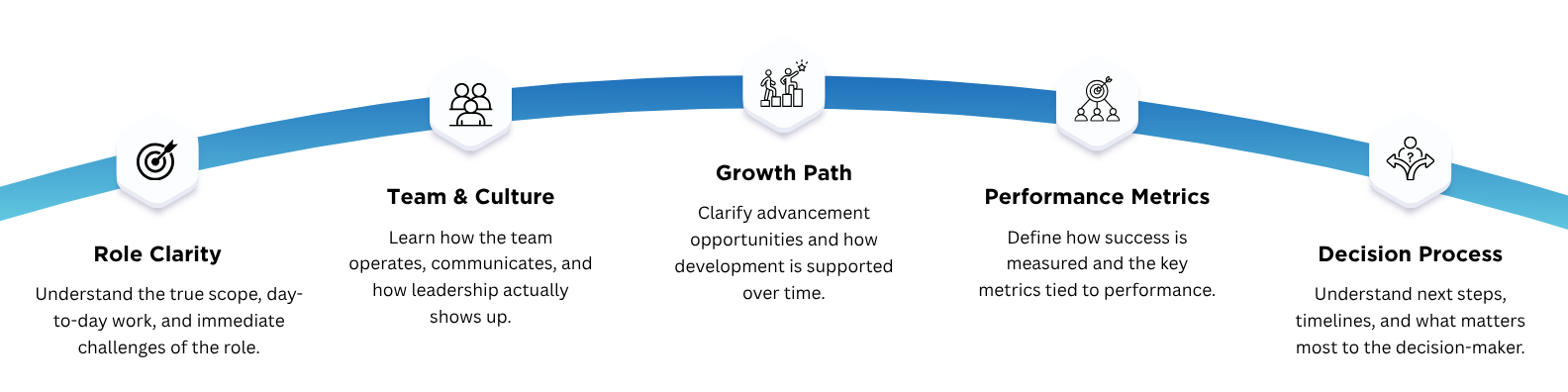
After years of coaching professionals through interview processes, we have found that the strongest candidates prepare questions across five categories. You will not cover all five in a single conversation, but going into this week with at least one sharp question from each puts you in a fundamentally different position than 90 percent of the candidates you are competing with.
1. Role Clarity
These questions move past the job description and into the reality of the position.
Why is this role open right now? Is it new, or a backfill? If it is a backfill, what happened with the previous person. Retention tells a story that no job posting will.
What does a typical week actually look like? Job descriptions are marketing documents. This question surfaces the operational reality.
What is the biggest challenge someone in this role will face in the first six months? The answer tells you whether the organization has thought about the role or just written a posting.
2. Team and Culture
You are not joining an organization in the abstract. You are joining a specific team, reporting to a specific person. That is what will determine whether you stay.
How long has the current team been in place? Tenure data is one of the most revealing signals a candidate can surface. A team that has turned over in the past year tells a fundamentally different story than one with multi-year stability.
How would you describe the management style of the person I would report to? This is a direct question, and candid answers are valuable. Hesitation, deflection, or generic responses are also information.
How does the team handle disagreements or competing priorities? The answer reveals the real culture beneath the employer brand.
3. Growth and Development
What does growth look like for someone in this role? Is there a defined path, or is advancement self-directed. Neither is wrong, but you should know which environment you are entering.
Does the organization support certifications, conferences, and continuing education? In healthcare, where credentials drive career trajectory and earning potential, this is not a perk. It is a core part of the offer.
Who was most recently promoted from a comparable role, and what did that progression look like? This is a concrete question that requires a concrete answer. If they cannot name a specific example, that absence is meaningful.
4. Performance and Expectations
What does success look like at 90 days and six months? If this was discussed in the interview but is not written into the role, ask for it in writing. Clarity protects both sides.
How is performance formally evaluated? Review cycles and feedback structures vary widely. Knowing which environment you are entering helps you manage your trajectory instead of reacting to a process you did not understand.
Which KPIs or metrics is this role measured against? For coding, CDI, audit, and revenue cycle roles especially, understanding the exact numbers you will be accountable for is essential context before day one.
5. Process and Decision-Making
What does the rest of the interview process look like, and what is the expected timeline? Every candidate should ask this. It sets mutual expectations and signals that you are managing your search with intention.
Is there anything about my background that gives you hesitation? Most candidates will never ask this because it feels uncomfortable. It creates an opportunity to address concerns in real time instead of discovering them in a rejection email.
What is the single most important quality in the person who ultimately fills this role? This cuts past the job description and surfaces what the decision-maker actually values. The answer often reveals priorities that were never in the posting.
Using Your Questions Strategically
The value of a strong question depends as much on when you ask it as what you ask.
Do not hold every question until the end. If the conversation opens a natural opportunity mid-interview, take it. The strongest interviews have the cadence of a professional conversation between two people evaluating mutual fit, not a presentation with a tacked-on Q&A.
Match your questions to the person across the table. With a hiring manager, focus on team dynamics and the reality of the work. With HR or a recruiter, focus on process, timeline, and total compensation. With a peer interviewer, ask what they wish they had known before they started.
Prepare more than you expect to use. Several will be answered organically. A deep list ensures you are never left with nothing to ask, and you never default to the response that communicates the least preparation: “No, I think you covered everything.”
Your Strategy Through Friday
If you have an interview this week or next: Open the Interview Questions Builder included with this edition. Select your role type, interview stage, and what you want to learn. It generates a tailored question set you can review tonight. Spend 15 minutes selecting the five questions that feel most relevant, then practice introducing them naturally rather than reading from a list.
→ Build your interview questions now
If you are actively applying but do not have interviews on the calendar: Audit the last three roles you applied to. For each one, write down what you actually know about the team, the manager, the growth path, and how performance is measured. If you cannot answer those questions for a role you are pursuing, that is the gap to close before Friday. Start with what is accessible. Revisit the job description, review the company’s LinkedIn page, and look at profiles of people in similar roles. If a recruiter or hiring contact is listed, reach out. If not, connect with someone on the team or in a similar position and ask a thoughtful question. The willingness to seek that information proactively is what separates a passive applicant from a candidate.
If you are earlier in your search: Take the Interview Readiness Scorecard included below. It takes five minutes and gives you an honest read on where you stand right now. Treat the results as a starting point, not a grade. Whatever it flags as a gap becomes your focus for the rest of the week.
→ Take the 5-minute readiness scorecard
The Midweek Mindset
The professionals who consistently land in the right roles are not the ones with the most impressive credentials or the longest tenure. They are the ones who walked into every interview knowing they were choosing, not hoping to be chosen.
The questions you ask are what make that shift visible to the person across the table. They signal that you have done the work, that you have a standard, and that you are evaluating the opportunity with the same rigor the organization is evaluating you.
Wednesday is the right day to sharpen that posture. The week is not over. There is still time to walk into your next conversation knowing that you belong at the table.
We will be back next Wednesday with Edition 2: how to tell your professional story without rambling, underselling, or sounding rehearsed.
For additional tips, resources and strategy beyond the newsletter, follow us across all socials!
LinkedIn | TikTok | Instagram | Facebook | Website | X (Twitter) | Job Board