



Salary transparency looks different everywhere. Some states require employers to post a range. Some do not. And even when a range is listed, it does not always tell the full story of what the role is actually worth or what the conversation will look like when it gets there.
What stays consistent is this. The professionals who walk into that conversation with confidence are the ones who did not wait to find out what the employer would share. They built their own picture first. They knew their market rate, understood the full scope of what they were considering, and showed up ready to have an informed conversation on their own terms.
That preparation is what this edition is about.
The Midweek Check-In
Before we get into the framework, lets take a moment to pause and think through three questions honestly.
In your last interview, when did the salary question come up? First call? HR screen? Second round? Somewhere in between? Take a moment to think about it. The timing alone tells you something worth knowing before it comes up again.
What did you say when it came up? A specific number? A range? Something like “I am flexible” or “it depends on the full package”? Whatever your answer was, we encourage you to sit with it for a moment. Would you say it the same way if you walked into that conversation today?
Do you know the actual market range for the role you are pursuing right now? Not roughly. Specifically. Low end, midpoint, and high end for your role, your experience level, and your geography. If that number is not clear yet, let that be your focus before Friday. Everything in this edition builds from it.
The Salary Research Toolkit is a simple tool to help you build your market range before any compensation conversation starts. Answer a few short prompts about your role, your experience level, and your geography and it puts together a range grounded in real data. Once you have that number, the Comp Conversation Script Builder helps you turn it into language you can use with confidence when the moment comes.
→ Build My Comp Conversation Script
The tools are free. Enter your first name, last name, and email to access.
The Shift That Changes Everything
The professionals who feel most confident in the salary conversation have made one shift in how they think about it. They stopped waiting for the conversation to unfold and started coming in prepared for it.
When you are waiting, the conversation feels reactive. Everything that follows is a response to whatever gets put on the table first. When you come in with your own research, it feels different. You already know what the role is worth in your market. You already understand the full picture of what you are evaluating. The conversation becomes something you are participating in rather than reacting to.
That shift does not require a different personality or a willingness to push hard. It just requires preparation.
Because preparation does not just help you navigate the conversation. It helps you evaluate the opportunity.
When you know your market rate going in, you have the information to decide whether the role is the right fit before the process goes further. Organizations set salary ranges based on a number of factors. Those ranges do not always reflect the full market value of the experience you bring.
Knowing your number before the conversation starts means you are never caught off guard by that reality. You are simply informed. And that changes everything.
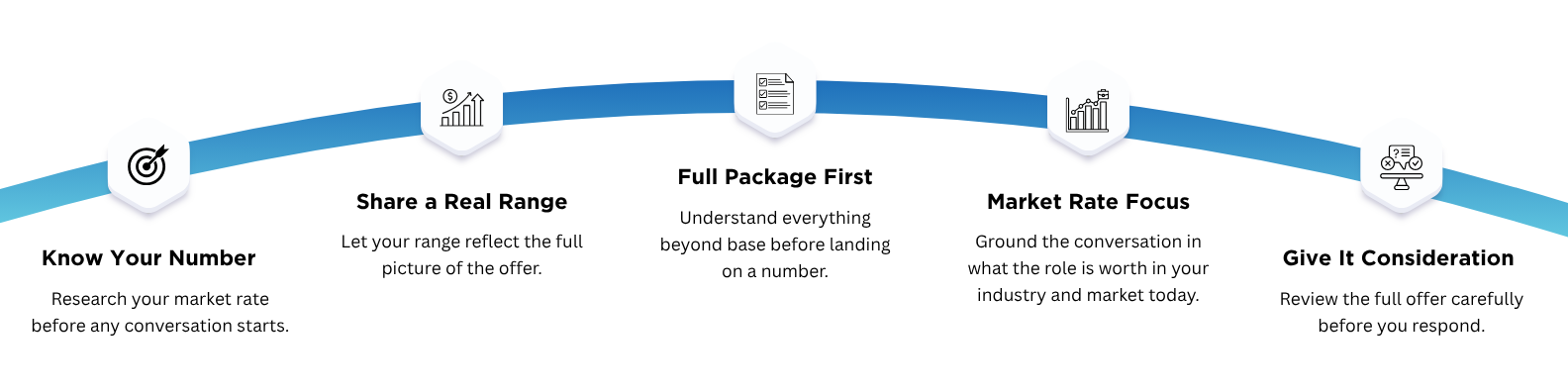
The Framework: Five Moves for the Salary Conversation
After coaching professionals across a wide range of industries and specialties through thousands of compensation conversations, the same five things show up consistently in the interactions that end with the strongest offers. Focus on the ones that fit the conversation in front of you.
Know Your Number Before the Conversation Starts
Market research is the foundation of any compensation conversation. What professionals in your role, at your experience level, in your geography are earning right now is the number worth knowing before anything else. Not roughly. Specifically. Everything that follows builds from that clarity.
Let Your Range Reflect the Full Picture
A range is almost always stronger than a single figure. And the right range accounts for what you do not know yet. Whether a salary was posted or not, whether there is a bonus structure or sign-on involved, whether the benefits are strong or modest. All of that affects what base salary needs to look like for the offer to actually work for you.
Not 85 to 95. Think 85 to 105. The bottom should be the number you would feel genuinely good about if the rest of the package is light. The top should be the number that would have you walking in on day one with full confidence regardless of what else is included.
Bring the Full Package Into the Conversation Early
Compensation is more than a number.
What the full offer looks like matters just as much as where the base lands. Bonus structure, remote or hybrid flexibility, PTO, professional development, sign-on, and growth opportunities all factor into what an opportunity is actually worth to you.
And that is different for everyone. A remote role might change the financial picture entirely when you factor in what you save on commute, meals, and daily expenses. A clear path to advancement might matter more than a higher starting salary. Strong continuing education support might be the thing that makes one offer stand out over another.
The point is that you get to decide what matters most. But you can only do that when you have the full picture in front of you.
“I want to make sure I am looking at the full package. Can we walk through what else is part of the offer, including bonus structure and any sign-on?”
The Conversation Belongs on the Market Rate for This Role
Every new opportunity is a chance to align your compensation with where you are in your career today and what the market reflects for the work you do.
In many states employers are no longer legally permitted to ask what you are currently earning, and in others it is still common. Either way, your next conversation does not have to be anchored to your last one. The market rate for the role in front of you is the right place to start.
Give Every Offer the Consideration It Deserves
An offer is the beginning of a decision, not the end of a conversation.
Where you work, how you grow, and what you earn shapes more than your career. It shapes your life. The role you accept next will influence where you are professionally and personally for years to come.
Giving yourself the space to review the full offer and come back with intention is always an option worth taking when you need it.
“Thank you, I am genuinely thrilled about this opportunity. I want to make sure I review everything carefully before we connect again. Can you send over the full offer and I will get back to you by end of week?”
Using the Framework Strategically
Knowing what to say matters. Knowing when to say it matters just as much.
And in a job market that feels as demanding as this one, that can be easier said than done. When you have been searching for a while, when the process has been long, when an offer finally lands, the pull to just say yes and move forward is completely understandable.
That is exactly why doing the research before the conversation starts matters so much. When you already know your number, you are not making the decision under pressure in the moment. You made it ahead of time, with clarity. And that changes how the whole conversation feels.
When you share your range, let it stand. A range grounded in real research does not need to be walked back the moment after you say it. State it, give the other person space to respond, and let the conversation find its footing from there.
Your Strategy Through Friday
If you have a compensation conversation this week or next
Start with the Salary Research Toolkit and build your target range before the conversation happens. Having that number ready changes how the whole discussion feels. Then use the Comp Conversation Script Builder to put your language together so when the moment comes you are not searching for the right words. You already have them.
If you are actively searching but do not have interviews on the calendar yet
This is the week to do the research. Pull your market range for the role you are pursuing, write down what the full package looks like to you, and know your number before anyone asks. The professionals who walk into the salary conversation most confidently are the ones who did this work before the process started, not during it.
If you are earlier in your job search
Start building your market knowledge now. Look at what roles in your field are paying across different geographies and experience levels. Follow the ranges. Notice what factors move the number up or down. By the time the conversation comes up you will already have a clear picture of where you stand and what you are looking for.
The Midweek Mindset
The salary conversation is one of the most personal moments in any job search. It is where your experience, your expertise, and the value you bring all come together in a single discussion. That deserves preparation.
Not because the conversation is something to fear. Because you have worked too hard and come too far to walk into it without knowing what you are worth.
Before you close this, take fifteen minutes and build your range. That one step changes everything that follows.
Wednesday is the right day to do it. The week is not over. There is still time to walk into your next conversation ready for it.

LinkedIn | TikTok | Instagram | Facebook | Website | X (Twitter) | Job Board