



There is a moment in almost every interview where the conversation turns to a part of your career history that is hard to explain in thirty seconds.
A gap. A pivot. A role that looks like a step back on paper. A period of time that meant everything to you personally but is difficult to frame professionally. You know it is coming. You have thought about it. And when it arrives, the pressure of the moment can make even the clearest explanation feel suddenly uncertain.
That moment does not have to feel that way.
The difference between walking into that conversation with confidence and walking in hoping it does not come up is almost always preparation. Not a perfect career history. Just a clear understanding of your own story and how to tell it.
That is what this edition is about.
The Midweek Check-In
Before we get into the framework, let us take a moment to pause and think through three questions honestly.
Is there a part of your career history that you tend to gloss over or avoid in interviews? A gap, a pivot, a role that is hard to explain in a way that feels right? Take a moment to name it. That is exactly where this edition is going to be most useful.
When you do talk about the non-linear parts of your history, does the explanation feel confident and clear or does it feel like something you are getting through as quickly as possible? There is a meaningful difference between the two and the hiring team can feel it too.
Have you ever stopped to think about what the non-traditional parts of your career actually demonstrate? Adaptability. Resilience. Range. Judgment. The ability to navigate uncertainty and come out the other side. Those are not gaps in your story. They are part of it.
If you want support putting your explanation into words before your next interview, the Career Gap Explainer below is built for exactly that. Answer a few short prompts about your history and it helps you shape a clear, confident response you can practice before the conversation happens. Once you have that, the Non-Linear Career Story Builder helps you pull the full picture together into a narrative that connects where you have been to where you are going.
→ Build My Career Gap Explanation
→ Build My Non-Linear Career Story
The tools are free. Enter your first name, last name, and email to access.
The Shift That Changes Everything
The professionals who handle this conversation most confidently have made one shift in how they think about their career history. They stopped seeing it as something to explain and started seeing it as something to own.
When your history feels like something to explain, the conversation becomes defensive. You find yourself over-justifying decisions and hoping the hiring team does not dig too deep. The focus stays on the past instead of where you are headed.
When you own your history, everything changes. The gap becomes context. The pivot becomes a decision that made sense at the time. The lateral move becomes evidence of range and self-awareness. You are not filling in blanks for the hiring team. You are giving them the full picture and letting your experience speak for itself.
That shift does not require a perfect explanation or a rehearsed script. It just requires knowing your own story well enough to tell it clearly.
Because here is what most hiring teams will tell you. They are not looking for a flawless career history. They are looking for a professional who understands their own trajectory and can speak to it with honesty and confidence. Those are two very different things. And only one of them is actually in your control.
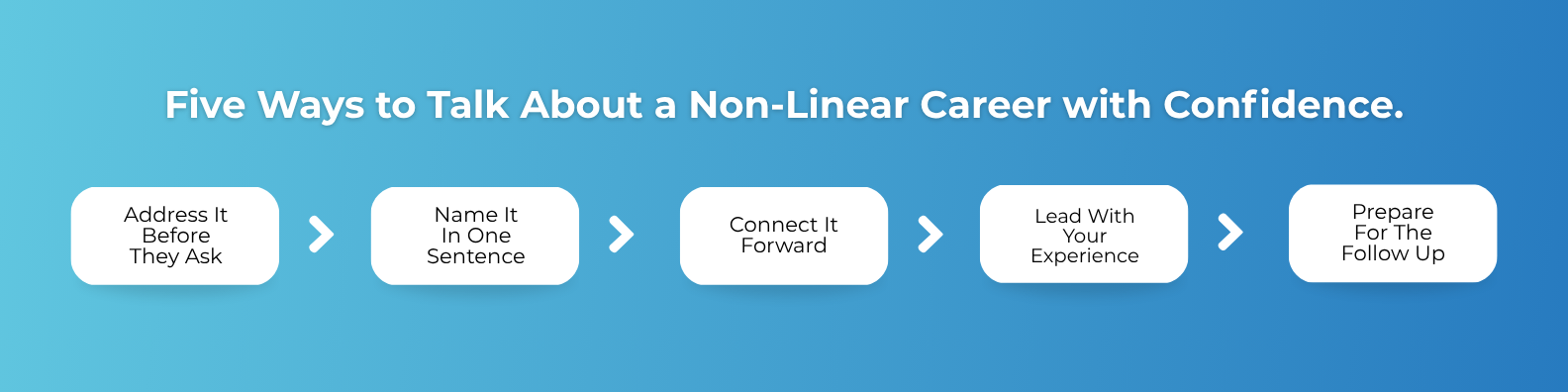
The Framework: Five Ways to Talk About a Non-Linear Career with Confidence
After working with professionals across a wide range of industries and career stages, the same patterns show up consistently in the explanations that land well and the ones that do not. These are the moves that make the difference.
01. Address It Before They Ask
The strongest move is not to wait for the hiring team to bring it up. Address the gap or pivot early, briefly, and with confidence.
Walking into the conversation ready to talk about it changes the entire dynamic. It signals self-awareness and openness. And it puts you in control of how the story gets framed rather than leaving that to whoever is sitting across the table.
02. Name It in One Sentence
The explanation does not need to be a story. It needs to be one clear sentence that names what happened, followed by what you did during or after that period and where you are headed now.
“I took time away to care for a family member who needed significant support. During that time I stayed connected to my field and I am now ready to return at the level my experience supports.”
That is a complete answer. It is honest, it is confident, and it gives the hiring team exactly what they need to move forward. The professionals who struggle most in this moment are the ones who keep talking after the answer is already done.
03. Connect It Forward
After naming the gap or pivot, build the bridge to the role in front of you. What did that period develop, even informally? What does the pivot demonstrate about your range? What does the non-traditional path bring to this role that a more linear background might not?
This is where the answer shifts from backward looking to forward looking. And that shift is everything. The hiring team stops thinking about the gap and starts thinking about what you bring.
“That experience gave me a perspective on this work that I would not have developed any other way. It is part of why this role feels like the right next step.”
04. Lead With Your Experience
The explanation of a gap or pivot should be brief. Name it, connect it forward, and then bring the conversation back to the substance of your experience.
The professionals who handle this best spend three sentences on the gap and the rest of the conversation on their work. That balance is what keeps the evaluation where it belongs. On what you bring to the role, not on what is missing from your resume.
05. Prepare for the Follow-Up
After any gap or pivot explanation the most common next question is some version of “can you tell me more about that?” Know the two or three additional details you are comfortable sharing and have a transition ready that brings the conversation back to the role.
“Happy to share more. What I will say is that it was one of the more formative periods of my career and it shaped a lot of how I think about the work I do now.”
When the Situation Is More Complex
Some career histories require a little more care. Here is how to approach the ones that come up most often.
A gap that involved a health or personal situation. You are not required to share medical or personal details in a hiring process. A clear, brief answer is enough.
“I took time away for a personal situation that has since been resolved. I am back to full capacity and not anticipating any future interruptions.” Honest, professional, and complete.
A pivot that looks like a step back. A move from a senior title to a lower one often reflects a deliberate decision that is not visible from the job title alone. Be specific about what you were moving toward.
“I made a deliberate move to gain experience my previous trajectory did not include. That decision has been directly applicable to the work I am pursuing now.”
A pattern of shorter tenures. Address the pattern directly, give honest context for each move, and then pivot to what you are looking for in a role that reflects a longer commitment. Demonstrating that you understand your own pattern and have made deliberate choices since is far more compelling than hoping it goes unnoticed.
Using the Framework Strategically
The way you feel about your own career history comes through in the room whether you intend it to or not.
When you are uncomfortable with a gap or a pivot, the hiring team can feel it. Not because they are looking for it. Because discomfort has a way of showing up in how quickly you move past something, how your energy shifts when a certain topic comes up, or how your answer suddenly becomes less specific than everything else you have said.
The work of preparing for this conversation is not just about having the right words. It is about getting to a place where you genuinely believe that your path, all of it, has brought you to where you are for a reason.
Your Strategy Through Friday
If you have an interview this week or next
Before you walk in, write out your explanation for any gap or pivot in plain language and say it out loud once. Not in your head. Out loud. Make sure it names the situation clearly, builds the bridge to where you are going, and takes under ninety seconds to deliver. That single exercise will tell you everything you need to know about whether it is ready.
If you are actively searching but do not have interviews on the calendar yet
This is the week to do the narrative audit. Write down every role, every transition, and every gap in chronological order. For each one write one sentence about why it happened and one sentence about what it built. That inventory becomes the foundation of a career narrative you can speak to confidently in any conversation, without having to figure it out under pressure in the moment.
If you are earlier in your search
Start thinking about your career history not as a timeline of jobs but as a story of decisions. What did each move teach you? What did each transition build? The professionals who tell their story most compellingly are not always the ones with the most linear path. They are the ones who understand their own trajectory well enough to speak to it with clarity and confidence when it matters most.
The Midweek Mindset
A non-linear career is not a liability. It is a true account of how you got here.
The part of your work history that feels the most complicated to talk about is often the part that shaped you the most. The gap that required you to slow down. The pivot that took courage. The role that looked wrong on paper but taught you something a straight line never would have.
Owning that story, all of it, is not just good interview preparation. It is an honest reflection of the professional you have become.
Before you close this, take fifteen minutes and write it down. Not the polished version. The true one. That is where the confidence comes from.
Wednesday is the right day to do that work. The week is not over. There is still time to walk into your next conversation ready for it.
LinkedIn | TikTok | Instagram | Facebook | Website | X (Twitter) | Job Board