



Each month the Bureau of Labor Statistics releases the Employment Situation Report, one of the most closely watched measures of labor market activity in the United States. Our team reviews it alongside what we are observing directly in active searches across healthcare, pharmacy, and the broader workforce. September’s report, released Friday, October 2, 2026, showed 29,000 jobs added nationally, below the twelve-month average of 45,000, with employment in all major industries changing little over the month. Health care continued to trend up. What follows is our analysis of what that data reflects and what it means for employers and professionals making decisions in the current market.
The September Employment Situation
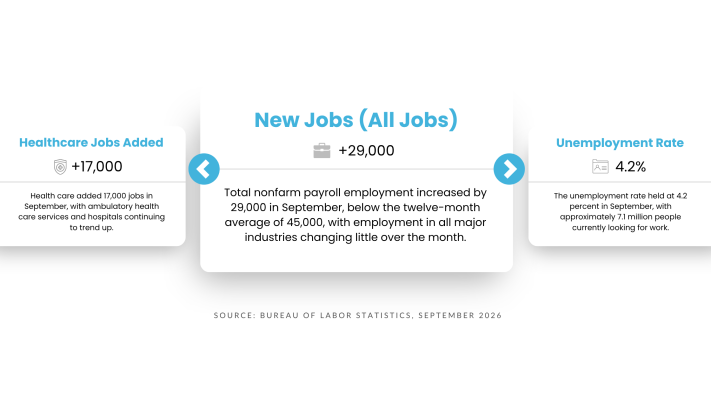
September’s Employment Situation Report reflected a labor market that continued to moderate heading into Q4. Total nonfarm payroll employment increased by 29,000, with health care remaining one of the most consistent contributors to job growth across the entire reporting cycle. Financial activities extended what has now become one of the most significant and sustained sector contractions of 2026, shedding positions for the sixteenth consecutive month. Manufacturing continued its recovery while construction held steady.
[BLS, September 2026: bls.gov/news.release/empsit.nr0.htm]
September sector snapshot:
- Health Care: +17,000
- Ambulatory Health Care Services: +13,000
- Hospitals: +12,000
- Construction: +11,000
- Manufacturing: +9,000
- Nursing and Residential Care Facilities: -9,000
- Financial Activities: -7,000
- All other major industries: little or no change
Health care’s structural foundation remains well documented and intact. BLS projects healthcare and social assistance will be the fastest growing sector in the economy through 2034, with approximately 1.9 million job openings projected annually driven by population growth, an aging workforce, and the continued expansion of outpatient and community based care models.
[BLS Employment Projections 2024-2034: bls.gov/news.release/archives/ecopro_08282025.pdf]
[BLS Occupational Outlook Handbook, Healthcare: bls.gov/ooh/healthcare]
What the Market Is Telling Us
Each month our team works directly with professionals evaluating their next opportunity and with organizations working to fill critical roles across healthcare, pharmacy, and the broader workforce. Three patterns emerged consistently across the positions our team supported in September.
1. Health Care Continued to Add Jobs While the Broader Market Slowed
For professionals actively exploring new opportunities in healthcare, the growth this month was most concentrated in ambulatory care and hospital settings. Functions like patient access, care coordination, revenue cycle, and specialty pharmacy continued to see the most consistent movement across the positions our team supported in September. For professionals with experience in these areas, the market is active and the demand is specific. The backgrounds advancing most consistently were the ones that clearly reflected the setting, patient population, and functions most relevant to where hiring is concentrated right now.
For organizations, ambulatory and outpatient functions remained the most competitive area for talent in September. The searches that moved most efficiently were the ones built around a clear and specific picture of what the role requires in today’s care delivery environment.
BLS, The Employment Situation, September 2026
2. A New Federal Drug Pricing Model Is Already Shaping What Organizations Need From Their Teams
On September 30, 2026, CMS finalized the GLOBE model, which ties Medicare Part B drug rebates to international pricing benchmarks beginning April 2027. For organizations managing physician-administered drug programs, the workforce implications are arriving ahead of the effective date. Reimbursement, pharmacy operations, and compliance functions are being built out now in preparation for a model that fundamentally changes how Part B drugs are priced and rebated.
For professionals with a background in specialty pharmacy, reimbursement, or healthcare finance, this is the kind of regulatory shift worth understanding and speaking to directly. The organizations moving on this now are actively looking for professionals who can connect their experience to where the reimbursement landscape is heading. If your background includes Part B drug programs, specialty pharmacy operations, or healthcare reimbursement, being able to articulate how your experience applies to the GLOBE model is a meaningful differentiator in conversations happening right now.
CMS, GLOBE Model Final Rule, September 30, 2026 HFMA, 2026
3. Financial Services Contraction Is Creating an Overlooked Talent Pool for Healthcare
Financial activities employment has now shed positions for the sixteenth consecutive month, declining 129,000 since May 2025. At the same time 60 percent of healthcare providers report significant hiring challenges in revenue cycle, health information management, and compliance functions.
For professionals coming from financial services who are evaluating their next direction, that overlap is worth understanding. Compliance expertise, data governance experience, and operational backgrounds developed in banking, insurance, and financial operations translate directly into what healthcare organizations are actively trying to fill. Revenue cycle compliance, audit readiness, health information management, and regulatory operations are all functions where that background is genuinely relevant and where demand is real. For professionals in this position, the most important step is connecting your financial services experience specifically to the healthcare functions it maps to before any conversation begins. For organizations, this is a talent pool that most are not yet sourcing from deliberately and one that is growing.
BLS, The Employment Situation, September 2026 Becker’s Hospital Review, Revenue Cycle Workforce Challenges, 2026
From Insight to Action
To support professionals navigating this market, we have compiled the primary sources behind the regulatory and legislative developments referenced in this edition. Each link provides direct access to the original guidance.
- CMS, GLOBE Model Final Rule, September 30, 2026
- HFMA, Revenue Cycle Resources, 2026
- Becker’s Hospital Review, Revenue Cycle Workforce Challenges, 2026
- FDA, Drug Supply Chain Security Act
- CMS, Medicare Annual Enrollment Period 2026
- ACA Marketplace Open Enrollment 2027, HealthCare.gov
- BLS Employment Projections 2024-2034
- BLS Occupational Outlook Handbook, Healthcare
Looking Ahead to November
The October Employment Situation Report releases November 6. September’s moderation raised a question the October data will begin to answer. Whether the labor market is entering a broader slowdown heading into year end or continuing the uneven monthly pattern that has defined 2026 will shape how both professionals and organizations approach hiring and career decisions through Q4. We will have that analysis in our November edition.
Two developments are worth having on your radar between now and then. Drug Supply Chain Security Act enforcement for smaller pharmacy dispensers takes effect this month, marking a shift from compliance preparation to operational execution for pharmacy teams across the country. For organizations that have been building toward this deadline, November is the proof point. For those still navigating implementation, the urgency is immediate. [FDA, DSCSA: fda.gov/drugs/drug-supply-chain-integrity/drug-supply-chain-security-act-dscsa]
Medicare Annual Enrollment Period is also underway through December 7, with ACA Marketplace open enrollment opening November 1. For the organizations and professionals supporting these populations across health plans, specialty pharmacy, and patient support functions, the next sixty days represent the most consequential operational period of the year. How teams are staffed and positioned right now will determine outcomes through the close of enrollment season.