

Each month the Bureau of Labor Statistics releases the Employment Situation Report, one of the most closely watched measures of labor market activity in the United States. Our team reviews it alongside what we are observing directly in active searches across healthcare, pharmacy, and the broader workforce. August’s report, released Friday, September 4, 2026, showed 162,000 jobs added nationally, above the twelve-month average of 31,000, with food services and drinking places, local government education, and manufacturing leading overall job growth. Health care continued to trend up. What follows is our analysis of what that data reflects and what it means for employers and professionals making decisions in the current market.
The August Employment Situation
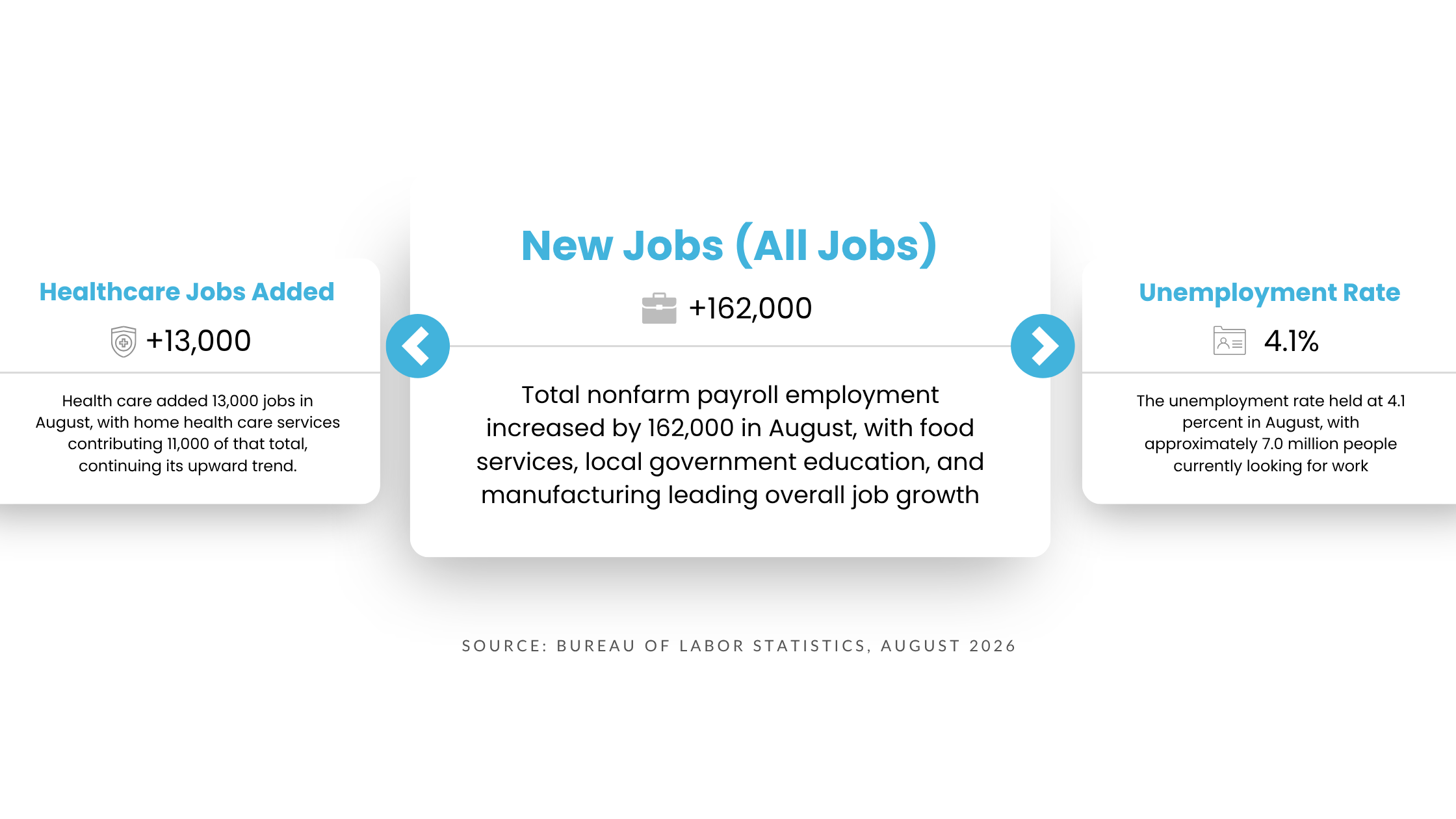
In August, employers added 162,000 jobs nationally, above the twelve-month average of 31,000. The unemployment rate held at 4.1 percent, with approximately 7.0 million people currently looking for work. Job growth was led by food services at 59,000, well above its twelve-month average of 12,000, followed by local government education at 42,000, which largely offset a decline in the prior month, and manufacturing at 16,000. Health care added 13,000, with home health care services contributing 11,000 of that total. The information industry lost 23,000 jobs.
Source: BLS, August 2026 Employment Situation
August sector snapshot:
- Food Services: +59,000
- Local Government Education: +42,000
- Construction: +22,000
- Manufacturing: +16,000
- Health Care: +13,000
- Home Health Care Services: +11,000
- Information: -23,000
The long-term outlook for healthcare is well supported by federal data. The United States population is aging and living longer with conditions that require ongoing care. BLS projects healthcare and social assistance will be the fastest growing sector in the economy through 2034, adding nearly 2 million jobs over the decade.
Approximately 1.9 million healthcare job openings are projected annually, driven by both sector growth and the replacement of experienced professionals transitioning out of the workforce.
Sources: BLS Employment Projections 2024-2034 and BLS Occupational Outlook Handbook, Healthcare
What the Market Is Telling Us
Each month our team works directly with professionals evaluating their next opportunity and with organizations working to fill critical roles across healthcare, pharmacy, and the broader workforce. Three patterns emerged consistently across the positions our team supported in August.
1. Specificity Is the Differentiator on Both Sides of the Market Right Now
One of the most consistent patterns our team observed in August is a meaningful shift in how organizations are evaluating candidates. Experience remains the foundation. What is creating separation at the offer stage is the specific context behind that experience.
Hiring teams are pressing beyond titles and years. They want to know the patient population a candidate supported. The call volume they handled. The drug programs or medication types they worked with. The payer mix their team managed. The size of the operation they came from. According to the American Academy of Professional Coders, 63 percent of healthcare providers report open positions in their revenue cycle departments right now. The demand is real. The professionals stepping into it most effectively are the ones whose background is not just strong but specifically articulated.
For professionals, the most actionable takeaway is straightforward. Before your next application or conversation, write out not just what you did but the specific context in which you did it.
2. New Programs and Policy Changes Are Creating Roles That Did Not Exist at Scale Before
Two developments are actively reshaping what healthcare and pharmacy organizations need from their teams and both are creating specific hiring demand worth understanding.
The 340B Drug Pricing Program is under significant pressure in 2026. On July 31, 2026 HRSA announced a revised 340B Rebate Model Pilot Program, providing qualifying drug manufacturers a voluntary pathway to deliver 340B pricing through rebates rather than upfront discounts. Manufacturers were required to submit plans by August 24, 2026 for an effective date of January 1, 2027. At the same time the current administration has proposed transferring oversight of the 340B program from HRSA to CMS, and the Senate has unveiled sweeping legislation to reform the program entirely.
For professionals with a background in pharmacy operations, compliance, or healthcare finance, the 340B landscape is creating opportunities that are specific, immediate, and growing as covered entities build out the administrative and compliance functions needed to navigate these changes.
Source: HRSA, 340B Rebate Model Pilot Program, 2026
GLP-1 medications are reshaping specialty pharmacy staffing at an accelerating pace. Expanded utilization is generating new patient support functions, HUB services positions, and specialty pharmacy roles that were not operating at this scale two years ago. For professionals in patient access, benefits verification, and specialty pharmacy, being able to speak to relevant experience within this space is increasingly a differentiating factor in how a background is evaluated.
Source: UnitedHealthcare, Pharmacy Trends, 2026
3. The Information Sector’s Contraction Is Creating an Overlooked Talent Pool for Healthcare
August’s report showed the information sector losing 23,000 jobs, with losses across computing infrastructure, publishing, and broadcasting. That figure matters beyond the headline because of what it means for healthcare and pharmacy organizations looking to fill specific functions.
Source: BLS, August 2026 Employment Situation
Many professionals coming out of the information sector bring backgrounds in data governance, health informatics, technology operations, and compliance that translate directly into health information management, revenue cycle technology, and clinical documentation roles. These are professionals with technical fluency and operational discipline whose skills align closely with where healthcare is heading.
For organizations with open roles in these functions, August’s information sector contraction represents a talent pool worth examining. For professionals from the information sector evaluating their next move, healthcare and pharmacy offer structural long term demand that is well documented. BLS projects healthcare and social assistance will be the fastest growing sector in the economy through 2034. The skills required to thrive in that environment increasingly overlap with what the information sector has been developing for years.
Source: BLS Employment Projections 2024-2034
From Insight to Action
To support professionals navigating this market, we have compiled the primary sources behind the regulatory and legislative developments referenced in this edition. Each link provides direct access to the original guidance.
- Bureau of Labor Statistics, The Employment Situation, August 2026
- Bureau of Labor Statistics, Employment Projections 2024-2034
- Bureau of Labor Statistics, Occupational Outlook Handbook, Healthcare
- AAPC, 2026 Healthcare Revenue Cycle Management Trends, via Auxis
- HRSA, 340B Rebate Model Pilot Program, 2026
- HFMA, How Hospitals Can Prepare for Heightened 340B Oversight, 2026
- UnitedHealthcare, Pharmacy Trends, 2026
- Medicare Annual Enrollment Period 2026, CMS
- ACA Marketplace Open Enrollment 2027, HealthCare.gov
- American Academy of Professional Coders, 2026
Looking Ahead to October
The September Employment Situation Report releases October 2. The figure worth watching is whether August’s momentum reflects a sustained shift in labor market direction heading into Q4 or a seasonal recovery driven by food services and local government education returning from summer patterns. Both scenarios carry different implications for hiring strategy and career planning through the remainder of 2026. We will have that analysis in our October edition.
The 340B and GLP-1 developments reshaping pharmacy and specialty pharmacy functions are moving quickly. Our October edition will report on how those changes are affecting the positions our team is supporting and what they mean for professionals and organizations navigating this space heading into the end of the year.